
decolonial intersections of rhetoric, African studies, critical futurisms, and critical development studies
The Center Cannot Hold: Decolonial Possibility in the Collapse of a Tanzanian NGO
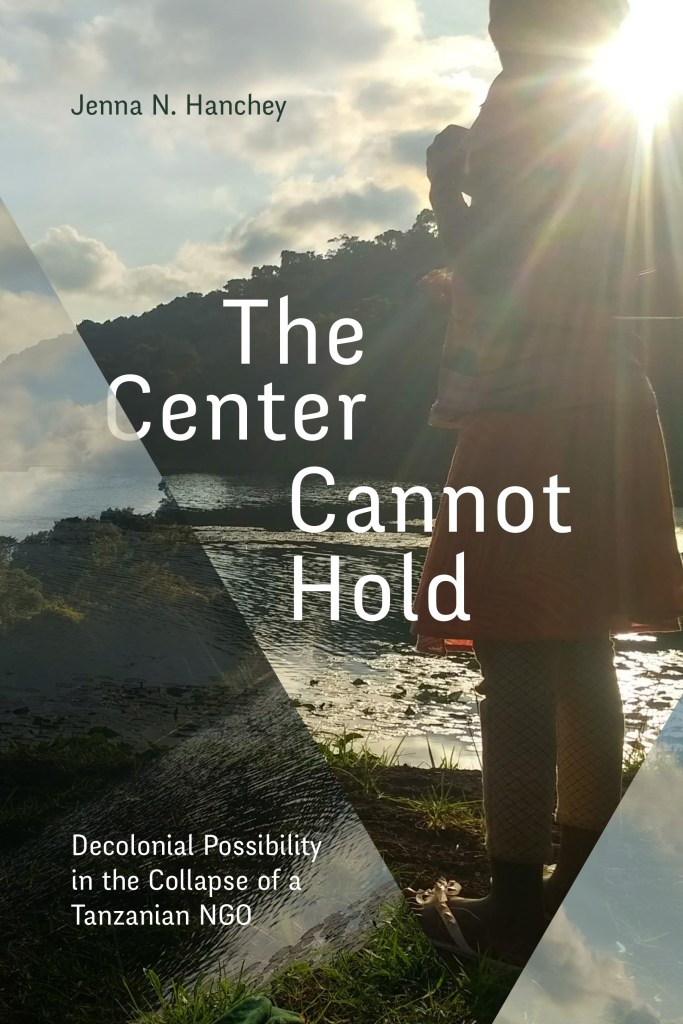
Winner of the 2024 Outstanding Monograph Award from the Organizational Communication Division of the National Communication Association
Winner of the 2024 Ellis-Bochner Autoethnography and Personal Narrative Research Award, International Association of Autoethnography and Narrative Inquiry (For Chapter 3, “Haunted Reflexivity”)
In The Center Cannot Hold Jenna N. Hanchey examines the decolonial potential emerging from processes of ruination and collapse. Drawing on ethnographic fieldwork in rural Tanzania at an internationally funded NGO as it underwent dissolution, Hanchey traces the conflicts between local leadership and Western paternalism as well as the unstable subjectivity of Western volunteers—including the author—who are unable to withstand the contradictions of playing the dual roles of decolonializing ally and white savior. She argues that Western institutional and mental structures must be allowed to fall apart to make possible the emergence of decolonial justice. Hanchey shows how, through ruination, privileged subjects come to critical awareness through repeated encounters with their own complicity, providing an opportunity to delink from and oppose epistemologies of coloniality. After things fall apart, Hanchey posits, the creation of decolonial futures depends on the labor required to imagine impossible futures into being.
Praise
“A true work of unlearning for relearning! Erudite, lucid, profound, and successfully shakes the foundations of Western messianism.” — Sabelo J. Ndlovu-Gatsheni, Professor and Chair of Epistemologies of the Global South, University of Bayreuth
“Jenna N. Hanchey is a brilliant storyteller, who leaves no theoretical or political stone unturned as she continually interrogates the relationships between selves and others in a complex contact zone. Her narratives of life at the Tanzanian NGO are well crafted and her research site becomes a powerful location for her to examine her own positionality in relation to land, white masculinity, and the colonial context in which the myth of the white savior permeates every interaction.” — Aimee Carrillo Rowe, author of Power Lines: On the Subject of Feminist Alliances
“In The Center Cannot Hold, Jenna Hanchey rigorously dismantles the assumption that non-governmental organizations (NGOs) that provide aid to countries in the Global South are fundamentally good and beneficial to the people they seek to help. Eloquently and engrossingly, Hanchey turns this assumption on its head by first tackling the underlying (neo)colonialist mentality that forms the basis of Western aid.” — Lana Medina, Women’s Studies in Communication
“Hanchey’s unique perspective, presented through engaging and accessible writing, encourages readers to begin the difficult work of actively creating a more just and equitable decolonial future.” — Faizat Oladunni Asifat, Rhetoric Society Quarterly
“Jenna Hanchey’s The Center Cannot Hold stands as a vital critique of the persistent onslaught of theoretical and conceptual innovations by western theorists entrenched in neoliberal assumptions that are, by design, doomed to fail African lands, peoples, knowledges, and futures. . . . Hanchey’s interdisciplinary text emerges as a welcome contribution that promises significant use and value for scholars across disciplines, levels of inquiry, and theoretical orientations. It also serves as a valuable resource for non-academic activists, educators, and professionals involved in community planning and development.” – Liahnna Stanley, Quarterly Journal of Speech
“The Center Cannot Hold is . . . in equal parts deeply moving, theoretically savvy, and filled with many vivid and engrossing descriptions, many readers will find the book and the arguments it makes eloquently written.” – Kundai Chirindo, Quarterly Journal of Speech
“Rhetorical scholars have a lot to learn from Hanchey’s impactful ethnographic work. She challenges rhetorical scholars to take risks with their methodology and to open up the spaces for the canon to fall apart in order for decolonial possibilities to emerge. This is not an easy task for western subjects who have been socialized to view the Global South as a desolate place and the people there devoid of theory. I believe this book will have a lasting impact on the emerging field of African communication studies, rhetorical studies, and organizational studies.” – Godfried Asante, Quarterly Journal of Speech
“The Center Cannot Hold offers unique insight into the rhetoric of both neocolonialism and decolonization as she considers her own experiences in and out of an NGO in Tanzania. . . . Hanchey’s scholarship teaches us that collapse can be generative, or even productive; that often for change to happen something needs to give.” – Allison Pujol, E3W Review of Books
Download the Introduction here.
Listen to a podcast interview about the book here.
Reviewed in Development & Change; Rhetoric Society Quarterly; Women’s Studies in Communication; Rhetoric and Public Affairs, and featured in a review forum in Quarterly Journal of Speech
Jenna N. Hanchey, Ph.D.
Public-Facing Essays
Jenna N. Hanchey, “Realizing Better Futures Now: On Speculative Relations: Indigenous Worlding and Repair by Joseph M. Pierce,” Ancillary Review of Books. September 16, 2025. https://ancillaryreviewofbooks.org/2025/09/15/realizing-better-futures-now-review-of-joseph-m-pierces-speculative-relations/
Jenna N. Hanchey, “Sitting with the Grief,” Los Angeles Review of Books, April 24, 2025. https://lareviewofbooks.org/article/sitting-with-the-grief/
Jenna Hanchey, “Slipping Between Worlds: Review of Darkly Lem’s Transmentation | Transience,” Ancillary Review of Books, March 17, 2025. https://ancillaryreviewofbooks.org/2025/03/17/slipping-between-worlds-review-of-darkly-lems-transmentation-transience/
Jenna Hanchey, “Africanfuturism Beyond the Future,” Strange Horizons. August 26, 2024. http://strangehorizons.com/non-fiction/africanfuturism-beyond-the-future/
Jenna N. Hanchey, “What Water Teaches Us,” Los Angeles Review of Books. July 11, 2024. https://lareviewofbooks.org/article/what-water-teaches-us-on-suyi-davies-okungbowas-lost-ark-dreaming/
Jenna N. Hanchey, “Fear of the Feminine: On Tlotlo Tsamaase’s Womb City,” Los Angeles Review of Books. January 23, 2024. https://lareviewofbooks.org/article/fear-of-the-feminine-on-tlotlo-tsamaases-womb-city/
Jenna N. Hanchey, “Going Mad: On Yvette Lisa Ndlovu’s Drinking from Graveyard Wells,” Los Angeles Review of Books. November 22, 2023. https://lareviewofbooks.org/article/going-mad-on-yvette-lisa-ndlovus-drinking-from-graveyard-wells
Jenna N. Hanchey, “On Prospect,” History of the Future. Center for Science and the Imagination, ASU. November 8, 2023. https://csi.asu.edu/calendar/events/the-history-of-the-future-prospect/
Jenna N. Hanchey, “Science Fiction Frames: Neptune Frost (2021),” Imaginary Papers. Center for Science and the Imagination, ASU. May 14, 2023. https://mailchi.mp/asu.edu/imaginarypapers14-may23
Jenna N. Hanchey, “Securing Neocolonialism: Reverse Extractavism in Tade Thompson’s The Wormwood Trilogy,” Strange Horizons. January 23, 2023. http://strangehorizons.com/non-fiction/securing-neocolonialism-reverse-extractivism-in-tade-thompsons-the-wormwood-trilogy/
Books
Jenna N. Hanchey, Decolonial Dreamwork: Africanfuturism and Imagination Beyond Development. Under contract with The Ohio State University Press. Supported by a Waterhouse Family Institute Grant, NEH Summer Stipend, ASU Humanities Institute Research Seed Grant, & Transformation Project Seed Grant.
Jenna N. Hanchey, The Center Cannot Hold: Decolonial Possibility in the Collapse of a Tanzanian NGO (Durham: Duke University Press, 2023).
Themed Issue Co-Editor
Jenna N. Hanchey and Godfried A. Asante, “(Re)Theorizing Communication Studies from African Perspectives: Part II,” The Review of Communication 22, no. 1 (2022).
Godfried A. Asante and Jenna N. Hanchey, “(Re)Theorizing Communication Studies from African Perspectives: Part I,” The Review of Communication 21, no. 4 (2021).
Journal Articles
Jenna Hanchey, “Cosmic Care,” Women’s Studies in Communication, OnlineFirst.
Jenna N. Hanchey, “Liquid Resistance,” ASAP Review. September 30, 2025. https://asapjournal.com/node/liquid-resistance-learning-from-water-in-sophia-samatars-the-practice-the-horizon-and-the-chain/
Jenna N. Hanchey, “Introduction: Review Forum on The Center Cannot Hold: Decolonial Possibility in the Collapse of a Tanzanian NGO,” Quarterly Journal of Speech 111, no. 2 (2025).
Jenna N. Hanchey, “After the End of the World,” Quarterly Journal of Speech 111, no. 2 (2025).
Laurie Fuller, Jenna N. Hanchey, and E Ornelas, “Existence as Resistance, WisCon 46, Mary 26-29, 2023, Madison, Wisconsin, United States,” Utopian Studies 34, no. 3 (2023): 618-625.
Jenna N. Hanchey, “It’s Time to Write Your Lesson Plan: Choose Your Own Future Fascism Series #8,” Liminalities 19, no. 2 (2023): 1-6.
Roberta Chevrette, Jenna N. Hanchey, Michael Lechuga, Aaron Hess, and Michael Middleton, “Rhetorical Field Methods/Rhetorical Ethnography,” Oxford Research Encyclopedia of Communication (2023): 1-37. Invited.
Jenna N. Hanchey, “Catastrophe Colonialism: Global Disaster Films and the White Right to Migrate,” Journal of International and Intercultural Communication 16, no. 4 (2023): 300-316.
Jenna N. Hanchey & Peter R. Jensen, “Organizational Rhetoric as Subjectification,” Management Communication Quarterly 36, no. 2 (2022): 261-287.
Jenna N. Hanchey and Godfried A. Asante, “African Communication Studies: Applications and Interventions,” The Review of Communication 22, no. 1 (2022): 1-6.
Godfried A. Asante and Jenna N. Hanchey, “African Communication Studies: A Provocation and Invitation,” The Review of Communication 21, no. 4 (2021): 271-292.
Jenna N. Hanchey & Godfried A. Asante, “‘How to Save the World From Aliens, Yet Keep Their Infrastructure’: Repurposing the ‘Master’s House’ in The Wormwood Trilogy,” Feminist Africa 2, no. 2 (2021): 11-28. Lead Article.
Jenna N. Hanchey, “The Dream Trainers,” Communication and Critical/Cultural Studies 18, no. 3 (2021): 305-314.
Jenna N. Hanchey, “‘The Self is Embodied’: Reading Queer and Trans Africanfuturism in The Wormwood Trilogy,” Journal of International and Intercultural Communication 14, no. 4 (2021): 320-334.
Godfried A. Asante & Jenna N. Hanchey, “Decolonizing Queer Modernities: The Case for Queer (Post)colonial Studies in Critical/Cultural Communication,” Communication and Critical/Cultural Studies 18, no. 2 (2021): 212-220.
Jenna N. Hanchey, “Decolonizing Aid in Black Panther,” The Review of Communication 20, no. 3 (2020): 260-268.
Jenna N. Hanchey, “Introduction: Beyond Race Scholarship as Groundbreaking/Irrelevant,” Departures in Critical Qualitative Research 9, no. 2 (2020): 122-125.
#ToneUpOrgComm Collective, “#ToneUpOrgComm: A Manifestx,” Departures in Critical Qualitative Research 9, no. 2 (2020): 152-154.
Jenna N. Hanchey, “Desire and the Politics of Africanfuturism,” Women’s Studies in Communication 43, no. 2 (2020): 119-124.
Peter R. Jensen, Joëlle M. Cruz, Elizabeth K. Eger, Jenna N. Hanchey, Angela Gist-Mackey, Kristina-Ruiz Mesa, and Astrid Villamil, “Pushing Past Positionalities and Through “Failures” in Qualitative Organizational Communication: Collective Lessons on Identities in Ethnographic Praxis,” Management Communication Quarterly 34, no. 1 (2020): 121-151.
Jenna N. Hanchey, “Reframing the Present: Mock Aid Videos and the Foreclosure of African Epistemologies,” Women & Language 42, no. 2 (2019): 317-346.
Jenna N. Hanchey, “Doctors Without Burdens: The Neocolonial Ambivalence of White Masculinity In International Medical Aid,” Women’s Studies in Communication 42, no. 1 (2019): 39-59.
Jenna N. Hanchey, “Toward a Relational Politics of Representation,” The Review of Communication 18, no. 4 (2018): 265-283.
Jenna N. Hanchey, “All of us Phantasmic Saviors,” Communication and Critical/Cultural Studies 15, no. 2 (2018): 144-160.
Jenna N. Hanchey, “Agency Beyond Agents: Aid Campaigns in Sub-Saharan Africa and Collective Representations of Agency,” Communication, Culture & Critique 9, no. 1 (2016): 11-29.
Robert W. Carroll, Madeleine Redlick, and Jenna N. Hanchey, “Is Rupaul Enough? Difference, Identity, and Presence in the Communication Classroom,” Communication Education 65, no. 2 (2016): 226-229.
Sarah Jane Blithe and Jenna N. Hanchey, “The Discursive Emergence of Gendered Physiological Discrimination in Sex Verification Testing,” Women’s Studies in Communication 38, no. 4 (2015): 486-506.
Jenna N. Hanchey and Brenda L. Berkelaar, “Context Matters: Examining Discourses of Career Success in Tanzania,” Management Communication Quarterly 29, no. 3 (2015): 411-439.
Kate Lockwood Harris and Jenna N. Hanchey, “(De)stabilizing Sexual Violence Discourse: Masculinization of Victimhood, Organizational Blame, and Labile Imperialism,” Communication and Critical/Cultural Studies 11, no. 4 (2014): 322-341.
Makiko Nagashima, Ken Kiers, Alejandro Szynkman, David London, Jenna Hanchey, and Kevin Little, “CP Violation in Three-body Chargino Decays,” Phys. Rev. D 80, no. 9 (2009): 095012-1-095012-10.
Book Chapters
Jenna N. Hanchey and Kaylee Mulholland, “Witnessing (to) Ghosts: Relational Approaches to Reflexivity through Haunting, SAGE Research Methods Cases (2025).
Liahnna Stanley and Jenna N. Hanchey, “Speculative Fiction as Rehearsal for Decolonization,” SAGE Research Methods Cases: Diversifying and Decolonizing Research (2024).
Jenna N. Hanchey, “Africanfuturism as Decolonial Dreamwork and Developmental Rebellion.” The Routledge Handbook to CoFuturisms, eds. Grace Dillon, Isiah Lavender III, Taryne Jade Taylor, and Bodhisattva Chattopadhyay (New York: Routledge, 2023).
Jenna N. Hanchey, “Afrofuturist Lessons in Persistence,” in Badass Feminist Politics: Exploring the Radical Edges of Theory, Communication, and Activism, eds. Sarah Jane Blithe and Janell Bauer (New Brunswick: Rutgers University Press, 2022), 276-291.
Jenna N. Hanchey, Ana-Luisa Ortiz, and Samantha Gillespie, “‘Graduate School is a Human Experience of Struggling, Celebrating, and Striving Together’: Graduate Life as A Collective Endeavor,” in By Degrees: Resilience, Relationships, and Success in Communication Graduate Studies, eds. Betsy W. Bach, Dawn O. Braithwaite, and Shiv Ganesh (San Diego: Cognella, 2021).
Jenna N. Hanchey, “Reworking Resistance: A Postcolonial Perspective on International NGOs,” in Transformative Practices and Research in Organizational Communication, eds. Philip Salem and Erik Timmerman (Hershey: IGI Global, 2018), 274-291.
Jenna N. Hanchey, “Constructing ‘American Exceptionalism’: Peace Corps Volunteer Discourses of Race, Gender, and Empowerment,” in Volunteering and Communication Volume II: Studies in International and Intercultural Contexts, eds. Michael W. Kramer, Laurie K. Lewis, and Loril M. Gossett (New York: Peter Lang, 2015), 233-250.
Jenna N. Hanchey, “Exceptional Opportunities: Hierarchies of Race and Nation in the U.S. Peace Corps Recruitment Materials,” in The Routledge Companion to Critical Management Studies, eds. Anshuman Prasad, Pushkala Prasad, Albert J. Mills, and Jean Helms-Mills (New York: Routledge, 2015), 384-397.
Fellowships & Grants
“Africanfuturism: Beyond Development.” $9,967, Waterhouse Family Institute, Villanova University, 2024
“Africanfuturism: Beyond Development.” $9,000, Institute for Humanities Research Seed Grant, ASU, 2023
Matching Grant. $3,000, Hugh Downs School of Human Communication, ASU, 2023
“Africanfuturism: Decolonial Dreamwork and Developmental Rebellion.” $6000, National Endowment for the Humanities (NEH) Summer Stipend, 2022
“Anti-Colonial Aid? Investigating the Potential of Cross-Cultural Dialogue in a Tanzanian NGO.” $9000, Waterhouse Family Institute Research Grant, Villanova University, 2018-2021
“A Postcolonial-Feminist Communicative Approach to International Aid Relationships in Sub-Saharan Africa.” $1000, ORWAC Research Development Grant, The Organization for Research on Women and Communication, 2015
William C. Powers Graduate Fellowship. $25,000 per year, The Graduate School, UT, 2012-2013 and 2015-2017 Jesse H. Jones Graduate Fellowship.$6500, Moody College of Communication, UT, 2014-2015
Research Awards
Ellis-Bochner Autoethnography and Personal Narrative Research Award, International Association of Autoethnography and Narrative Inquiry, 2024.
Outstanding Monograph Award, Organizational Communication Division, National Communication Association, 2024.
Distinguished Themed Edited Journal Award, Philosophy of Communication Division, National Communication Association, 2023
Best Special Issue Award, Ethnography Division, National Communication Association, 2023
New Investigator Award, Critical & Cultural Studies Division, National Communication Association, 2022
Early Career Award, Rhetorical and Communication Theory Division, National Communication Association, 2022
Outstanding Article Award, Critical and Cultural Studies Division, National Communication Association, 2022
Outstanding Article Award, Feminist and Gender Studies Division, National Communication Association, 2021
Best Article Award, Ethnography Division, National Communication Association, 2020
Feminist Scholar of the Year Award, Organization for Feminist Research on Gender and Communication, 2020
Outstanding Dissertation Award, Critical and Cultural Studies Division, National Communication Association, 2017
Outstanding Master’s Thesis, International and Intercultural Communication Division, National Communication Association, 2013
Top Master’s Thesis in Qualitative/Rhetorical Scholarship, Master’s Education Section, National Communication Association, 2012
 Jenna Hanchey