Read, Listen, Watch, Look: 2025 Across Media

It’s that time of year where everyone in SFF is posting their eligible pieces for awards. I love seeing people celebrated, but I must admit that the comprehensive lists of everything everyone has ever done this year are a little overwhelming to me! In case there are others out there like me who need more direction, I’ve curated a small list of some of my pieces, each focusing on a different medium and mode of engagement, so that you can choose the type of experience that speaks to you. Enjoy!

~BUT FIRST, SHOUT-OUT TO A FRIEND~

** READ: ESSAY **
Photon Torpedoes Break the Space Muqarnas: SFF Audiovisuals and Anti-Muslim Violenceby Tanvir Ahmed

“We might say that the correlation is straightforward, that acceptance of fantasy violence against not-Muslims prepares our souls to accept real violence against Muslims. I might have made the argument, once. But the genocide in Gaza has forced me toward another possibility—that I would be wrong to presume the separation between fantasy violence and historical violence, and the separation between not-Muslims and Muslims.”

This essay is eligible for the Hugo award for Best Related Work, the British Science Fiction Association award for Best Short Nonfiction, and the British Fantasy Award for Best Nonfiction.

~ON TO THINGS JENNA HAS BEEN INVOLVED IN~

** LISTEN: PODCAST **
Just Keep Writing, cohosted by Marshall Carr, Wil Ralston, Nicholas Bright, Brent C. Lambert, LP Kindred, Gabriel F. Salmerón, Shingai Njeri Kagunda, Sameem Siddiqui, and Jenna Hanchey

Nothing holds as much meaning for me this year as joining the exceptional community at JKW. If you’re looking for an encouraging writerly podcast (or Discord server!), this is the place.

My first episode with them was on “Writing through Executive Dysfunction,” and helped me cope in a time when the words just weren’t coming.

The podcast as a whole is eligible for the Hugo Award for Best Fancast, and individual episodes are eligible for the British Fantasy Award for Best Audio Work.

** LISTEN: NARRATION **
“Coming Through in Waves” by Samantha Murray, narrated by Jenna Hanchey

I loved the experience of reading this beautiful story of the grief of losing someone who’s still present with you. I hope the narration moves you as much as the story moved me.

The narration is eligible for the British Fantasy Award for Best Audio Work, the Hugo Award for Best Dramatic Presentation – Short Form, and the Nebula Award for Best Dramatic Presentation.

** WATCH: 1/2 ESSAY & 1/2 STORY **
Resistance in Speculative Fiction and Beyond” presented by Jenna Hanchey and Tanvir Ahmed, facilitated by Matt Bell

The ASU Worldbuilding Initiative, led by Matt Bell, invited Tanvir and I to present on resistance — and it was fire. I gave a talk on liquid resistance in African SFF from my forthcoming book manuscript, and Tanvir read the gorgeous story “Wilayat in Seven Saints,” before the three of us sat down to talk more about intimacies and structures together.

This presentation is eligible for the Hugo Award for Best Related Work.

** LOOK: VISUAL POEM **

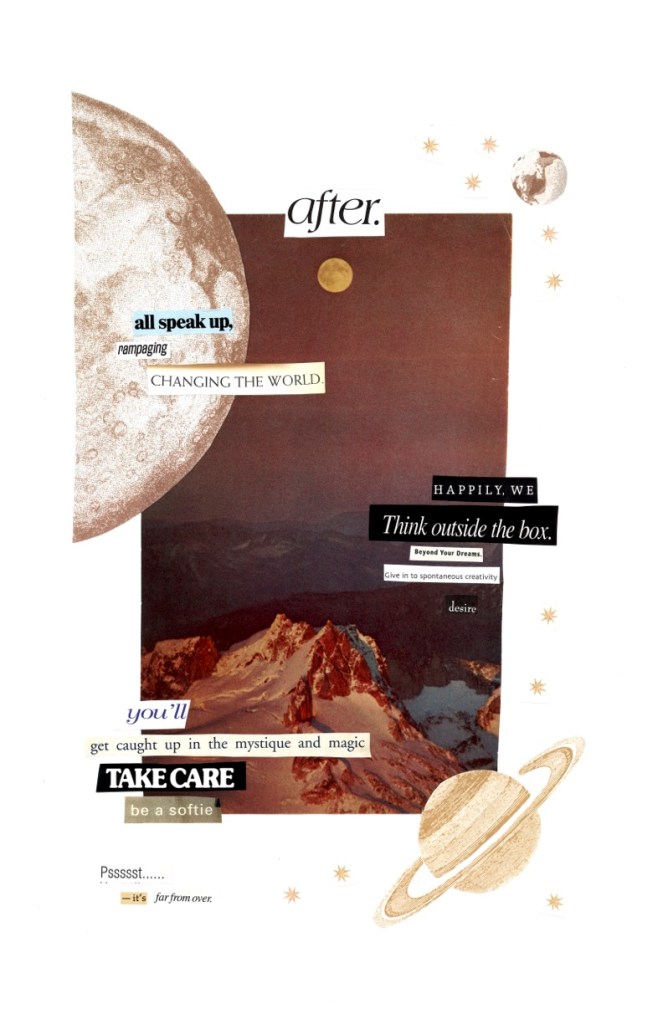
“After,” originally published in the April 2025 double issue of Worlds of Possibility

I’m so grateful to Julia Rios for not only seeing potential in my artwork, but recognizing it as poetry as well.

Here is the artist statement I published with the work:

“‘After’ is inspired by those in my life who have the bravery to be soft and vulnerable in a world that makes that dangerous and scary, and the deep and beloved connections we’ve formed together across differences, dreaming of collective change that can enable worlds where such softness and vulnerability don’t have to be so risky–emergent worlds of reciprocity and care.”

After by Jenna Hanchey, originally published in the April 2025 double issue of Worlds of Possibility

This poem is eligible for the special Hugo Award for Best Poem and the Nebula Award for Poetry.

Please feel free to link your proudest publications of the year below!

Celebration Beyond Accomplishment

Yesterday I signed the paperwork officiating my tenure and promotion to Associate Professor at Arizona State University. Many of my friends, in the midst of congratulating me, asked how I feel. And I don’t know.

Yesterday, as well, my first professional artwork was also published: a collage titled “After” in Worlds of Possibility. I know how I feel about this one. I’m beyond giddy that something so deeply meaningful and encouraging to me may find resonance in the hearts of others, people I know and love dearly, and those I may never have the chance to meet.

I’m trying to parse what makes me so ambivalent about tenure. It’s an accomplishment that many people aim their lives toward, constantly mapping its facets for years — What do I have to do, by when, in order to achieve tenure and the job security that comes with it? What and whose expectations do I have to meet to make it? What kind of hoops do I have to jump through and how quickly? — and acting in accordance.

The question of what comes next is often sidelined. More importantly, so is reflection over what we turn ourselves into through this continual hustle to meet expectations. What kind of person have I been cultivating by trying to read, infer, and unerringly meet the ever-shifting standards set to cross this imperceptible bar? What has it done to my political and ethical commitments, let alone understanding of self in relation?

In April 2024, as I turned in my tenure packet, I realized academia would always ask more from me if I let it. And it would be a certain kind of more, not the more of consistent struggle for decolonization or liberation, but a more defined by the structures of the academy and aimed at their continued reproduction — more articles, more committees, more meetings, more awards, more to attempt to validate the system is working.

The system isn’t working. I’m told I need to publish articles in peer-reviewed journals because they’re more prestigious or rigorous, but the journal claims copyright, puts the work behind a paywall, and then sells it as data to train generative AI. I’m not only uncompensated for this work, but I would have to pay the journal to reprint my own essay in the future. And they’re making money off of it, both in selling access and using it to train AI they hope to have do this free labor in the future.

The system is racist and extractive. Those articles that make it that far in the first place have to go through peer review that is often a form of white supremacist gatekeeping, holding scholars to canon and field as a means of policing the politics of the argument such that it doesn’t radically challenge the status quo. All the while, knowledge from marginalized communities is used to build the canon, but exoticized and reductively called “data” rather than “theory,” the fragments that whiteness chips off holistic worldviews so that it can piece things together the way it wants and then call the creation universal knowledge while the fragments were dismissed as localized culture.

This is not a system I want to reproduce. So I’ve been spending this year pausing. Asking myself what actually aligns with my political commitments to decolonization, community building, and imagination, as opposed to what I think I need to do because it’s expected of me. I’ve been rehearsing saying no to the latter, even when it’s viewed as necessary to my work.

It’s not. It’s not necessary to my work. It’s the labor necessary to maintain the system. Those are two different things. I want my work to be something different. I want to demonstrate something different through my work.

When it comes down to it, the job security tenure affords is only job security insofar as the system remains as it is. I understand why that leads some to aim their efforts at reinforcing the structure, securing its maintenance, keeping it in place.

I do feel a relief at having tenure. It’s a momentary weight off. But I harbor no illusions that it means the weight is off forever. Nor that I could keep it off if I tried. I could try — I could do everything expected of me, feed right back into that machine that constructed tenure in the first place, try to ensure this feeling of relief remains forever.

Of course, doing so would simply be shouldering the weight of meeting expectations again. The act of attempting to secure the relief would, in the act, take it away. I would pick the burden right back up out of fear of losing the security I never can actually hold.

Tenure is an accomplishment, but it’s not the substance of what I’ve been creating. It’s a marker that others recognize that substance, have deemed it valuable. But the people affording me tenure are not actually the audience I want to reach. And I already know the value of my work.

If I had to choose which one I would most like to celebrate today, it’s the collage. Publishing artwork is also an accomplishment, surely. But the artwork holds substance — in its inspiration, in the act of creation, in the meaning I make of it, and the meaning it allows others to make. It’s something that could only come into being through relations with others, and marks that network more than it does a solitary achievement.

Here’s what I wrote in my artist’s statement:

“After” is inspired by those in my life who have the bravery to be soft and vulnerable in a world that makes that dangerous and scary, and the deep and beloved connections we’ve formed together across differences, dreaming of collective change that can enable worlds where such softness and vulnerability don’t have to be so risky–emergent worlds of reciprocity and care.

Frameworks developed from whiteness and coloniality place emphasis on individual achievement over collective meaningmaking, and ask us to celebrate having won, conquered, or dominated. But I want to celebrate the softness. The vulnerability. The tentative connections that grow from fragility to strength through attention and care. The friction that sharpens and hones. The grief that we weather together. The transformations we hold each other through. The laughter that leaves us unable to breathe for a few moments of sheer, overwhelming joy.

Today I’m celebrating creating art that brings us together. And I’m celebrating this moment of rest and rejuvenation I have, knowing that it affords an opportunity to recommit to the decolonial labor I want to partner in, build community connections even stronger, and imagine more boldly beyond what we’re handed.

Today I’m celebrating the ways that relations sustain and enable, and what we can create through those networks of support.

On Panic at the End of a World

The past two weeks since my 40th birthday have induced many people in the US to panic. We’ve watched in horror (if lacking surprise) as particularly immigrants, trans folks, Palestinians and those who advocate for them, and disabled people, (as well as anyone suspected of engaging in that sneaky “DEIA” work) were placed under increasing threat. Our hearts beat faster and our breathing got ragged as we scrolled through article after article, leak after leak. Our vision shrank, our sweat trickled down. We panicked.

And when E— M— illegally took control of sensitive servers and shut down USAID, we said—

Wait, let’s pause. We’re on the edge of a shift here, do you see? We were feeling, sensing, engaging our bodies. We’re about to do something different.

—we said, “It’s a coup! It’s a constitutional crisis! It has to be stopped!” It felt like the end of the world.

We named it. We interpreted what it was, but not just that: We interpreted what our feelings meant. And with that interpretation came conclusions about what to do. Our heartbeats told us we needed to do something now Now NOW. Our breathing told us we were in immediate danger. Our vision narrowed to what we, lone individuals, could do to protect our selves our family our friends our people. And our sweat blamed us when we, as lone individuals, were so overwhelmed with the sheer magnitude of the problem that we completely shut down. Because what, in the face of the end of the world, can one lone individual do?

But…can we return to the pause? The moment before? When we were feeling, just feeling? Could it go a different way?

—we said, “It’s a coup. It’s an outgrowth of the white supremacist and settler colonial structures that we’ve enabled to get this far. The world that this grew out of needs to be remediated.”

Pause. Breathe. What does it mean to feel our feelings, sit in them and move in them and allow them to wash over us? Even when it feels like the end of a world?  

I’m someone who feels very deeply, and that has brought with it struggles with anxiety. But over the last year or so, I’ve been reading more about Indigenous ethics and it’s been helping me recognize that the ways I learned to interpret my anxieties are not just a problem because therapeutic frameworks make them so, but because they reinvest in colonial structures.

You see, I’ve felt these same feelings of panic before, many times. Fast heart, shallow breath, sweaty palms. Except: Once it was simply trying to make sure a group of African speculative fiction guest speakers got to a university-sponsored panel on time. Just that. Nothing near the level of governmental coup. But I felt the pressure of invisible consequences, even if I couldn’t put my finger on exactly what they were. Shingai Njeri Kagunda in particular noted my anxiety and how it was manifesting and asked, “Have you ever read about the white supremacist sense of urgency?”

I hadn’t. But after that I did. In 1999, Tema Okun wrote a list of characteristics naming how white supremacy structures organizational culture, and it continues to be just as relevant as it was when originally published. Reading it, I recognized a lot of the aspects of white supremacy culture from not only the organizations I took part in, but the ways that I myself took part in them. One of those aspects was the sense of urgency.

This needs to be fixed.

This needs to be fixed now.

And it needs to be fixed by me.

At this point you might be starting to get itchy, thinking to yourself, “Wait, is she saying that this coup isn’t urgent? That we shouldn’t fix it?”

No, not at all. What I’m saying is that the way white supremacy culture has made a sense of urgency feel ubiquitous means that we’ve internalized responses that won’t actually fix it. As Okun describes, “The irony is that this imposed sense of urgency serves to erase the actual urgency of tackling racial and social injustice.”

Let’s think about this: What does the white supremacist sense of urgency ask us to do in response to E— M—’s destabilization of the US dollar and dissolution of USAID? It needs to be fixed, and it needs to be fixed now, and it needs to be—

—returned to the status quo. Enshrined tighter, perhaps, so that no one can ever threaten it like this again. We’ll breathe easier, we think, when USAID is safely back in place. When the US dollar again sets the groundwork for global currency. When our stock markets control global financial flows again.

When everything’s back to normal.

That is, white supremacy culture is what tells us this is the end of the world, instead of the end of a world. It advocates for putting everything back where it was and fortifying the walls around it so that the systems we have, built in stolen Native lands with the labor of enslaved Black people, can be even further entrenched in place.

The white supremacist sense of urgency doesn’t let us get to the more complicated question: What if we’ve reached this crisis precisely because the world we’ve built has been built through the very same logics underlying the takeover we’re currently seeing? That this isn’t so much a constitutional crisis as it is a constitutional outgrowth: An extension of the ways that rights have always been differentially distributed, with some people being understood as things to bolster the humanness of others, in this country.

Pause. Breathe. Feel. What do we do with these feelings, then?

We feel them. And then pause. And before interpreting what comes next, we breathe and remember how the air connects us to everything on this planet. How we are composed of water, just like the ocean. And resist the urge to individualize, to think we’re the only people who feel or have ever felt these feelings. Instead, we reach out, feel the porousness of our experience, and connect to the deeper context that remembers everyone whose world has ended before, whose worlds continue to end precisely because of the way the US government has been operating up until this point. And we advocate, together, for something beyond the status quo to which urgency would have us return.

What does it look like to make sure people have longterm and consistent access to HIV/AIDS medication without it relying on a structure that was constructed as a form of Cold War anticommunist soft power? What might it look like to engage with other countries through equitable and reciprocal relations rather than paternalistic forms of control? What kind of world might allow for the distribution of pharmaceuticals in ways that center people’s lives and wellbeing rather than profit? What might governmental moves toward the dissolution of capitalist imperialism look like? How can we advocate collectively for all of this, rather than a simple return to what we’ve had in place?

The US is in crisis. One world is ending. What will we dare to imagine in its place?

A Year of Flight and Color

Today is my 40th birthday. It’s also the day that a flurry of executive orders threatening the well-being of many people I love are expected to be signed, and a few days into a tentative ceasefire after over a year of genocide and devastation in Gaza. What does celebration mean in a world on fire? What does it look like to protect moments for joy while refusing to turn away from the terror and pain that surrounds it? How do we hold space for happiness at the same time as horror?

I’ve been wrestling with these questions this week, certainly, but it’s simply a microcosm of the way I’ve long considered my place within such complexities. You see, I’m a joyful person. I’m always looking for the aspects of beauty around me. And I will laugh until I lose my breath, even when surrounded by death. If there’s something I’m ready to grasp hold of now, as I enter a new decade, it’s that this can be a gift.

It’s not always, certainly. Toxic positivity abounds, and there are ways that looking for beauty can be used as a means of ignoring power, sweeping the effects of domination under the rug–pretending as if people aren’t dying around you, as if you yourself aren’t part of the system causing the harm. And white women in particular are adept at using “joy” and “beauty” in this way, as a means of willed ignorance and desperate grasping for innocence.

At some points in my life, I did as well. And my first inclination, when facing how whiteness uses positivity to obscure power, was to overcorrect, to think that I could never be joyful, that that was always a function of privilege. But the more I read Black feminist writers, deepened relations with BIPOC friends, engaged in queer and trans community, the more I realized joy in the midst of pain–holding both at the same time–is necessary. That laughter pulls us through. That my tendencies toward finding those moments, holding tight to them, making space in them for others to enter, can be useful for collective struggle. And that to attempt to squelch something so deeply meaningful to me–and at which I’m talented–is not the answer. What I needed to figure out was how to use it well.

Earlier this year, I read a story of mine called “The Devil’s Hand” on Story Hour. It’s a silly story, taking down power structures with baking and cat videos. Not one I would consider among my most meaningful, or important. But a friend of mine watched the recording, and a few days later, thanked me profusely for it. “Thank you for making me laugh,” he said. “In the midst of everything happening, I really needed to laugh.” He told me my humorous stories were important–they gave a little bit of joy to those wracked by pain. That I should write more of them. Because there would always be people who need a reason to laugh.

I’ve been thinking a lot since then about how finding moments of joy and levity can be a talent, how I might lean into it as means of building radical community and opening spaces for imagining liberation–and how accepting what brings me joy can put me in a healthier position for supporting others. Joy can act as a means of igniting passion for continuing the fight against systems of oppression, as well as sharing the intimate moments of connection that ultimately are what make such fights meaningful.

Here, at the edge of 40, I don’t know what the next decade holds, but I know what I carry with me. Over the past three years, I’ve marked the turning of the year (quickly followed by my birthday) with setting a theme, if not precisely an intention. Each of these years the theme took on unexpected life, teaching me deeper lessons than I anticipated.

2022 was a year of fire. I left my partner of over a decade, as well as my job and city, and moved alone to Phoenix, burning things down and rebirthing anew in the ashes.

2023 was a year of water, of the magnitude of the sea. Having freed myself of an emotionally abusive space, I needed to sound the depths of my own feelings, discover how much they could hold, how much pressure, how much depth. I was startled by how much feeling my body could hold, after years of numbness.

2024 was a year of land, of rooting in relation and reciprocity. After sounding my own depths, I found my footing once more through rooting deeper in relation to land, water, season, place, and community. I learned how to better respect others’ agency (whether human or beyond) as well as my own, to express what I desired and allow others the space to respond.

And here we are in 2025, a year of wind. Of, as I titled this post, flight and color. When I expressed this theme to my queer life coach, he suggested that wind is also what powers voice, and that this could be a space for exploring and expressing my own intuition. I didn’t really expect it when I started writing this post, but I think part of what I know, what I’m ready to express, what I carry with me into my 40s, is a sense of how my capacity for joy can be a gift to those around me–and that the work I’ve done over the past three years in particular has prepared me to use it as such: I began anew, creating the space to decide what commitments I wanted to live by (i.e., justice, community, imagination) and plumb the deep recesses of myself and evaluate whether I am doing so well, and what needs to change if not; community is what enables that kind of growth, and so I focused on rooting, deepening intimacies and relations, transforming as I did; and now, I’m ready to lift off, take flight, watch as brilliantly-colored wings flash for just a moment, reflecting the sun.

Even amidst the storm.

I created this collage for the year, thinking only of wind, and was surprised by the amount of color, the vibrancy. It’s currently hanging on my front door, so I see it every time I leave the house.

This year will certainly not be easy. But there will be flashes of color, moments of vibrant joy, spaces that urge you to take flight.

For my birthday, take a moment to celebrate with me by exploring your own gifts. What are the talents calling for your attention? Things that bring you joy, that you deeply desire, that you might also turn toward strengthening intimacies across difference, coalitions for justice, collective imagining, even–and most importantly–in the midst of all the pain?

Hold it all. Hold each other. Hold on.

2024 – Reading in Review

Hello darlings! In the new year, I plan on using this space more often to overview things I’m reading, things I’m writing, and personal growth and thought. I’m hoping to put up a couple posts as we transition into 2025… and the first of those is my 2024 Reading in Review!

A couple weeks ago, I did a Bluesky post saying that for every “like” I received, I’d talk about a book that I read and loved in 2024. Now, I got too many likes, so I must admit that I dipped a little back into 2023, as well. I’m reposting all of the books I mentioned here so they’re easier to find, with attendant links to how you could purchase them (predominantly through my local indie radical community organizing space, Palabras Bilingual Bookstore). Hope you find something here you enjoy! (Consider giving the author a shout-out if you do =) )

In no particular order, here are Jenna’s 50ish Beloved Books of 2024 (+ a few bonus 2023):

1. How to Fall in Love in a Time of Unnameable Disaster by Muriel Leung

This novel of queer longing and loss in a post-apocalyptic New York, where acid rains create disconnection in what used to be walking distance, and ghosts suddenly live among us, came to me at just the right time ✨

2. Indigenizing Philosophy through the Land: A Trickster Methodology for Decolonizing Environmental Ethics and Indigenous Futures by Brian Burkhart

The most thought-provoking book I read this year, it completely reoriented how I understand coloniality and relate to land. Transformative for me.

3. Love After the End: An Anthology of Two-Spirit and Indigiqueer Speculative Fiction ed. by Joshua Whitehead

I’m a romantic, okay?? I read this in one sitting on a plane and sobbed quietly the whole time from the tender way it holds beauty and pain, love and loss, together in intimate relation.

4. Lost Ark Dreaming by Suyi Davies Okungbowa

I know, I know, I’ve already shouted about this one (*ahem* lareviewofbooks.org/article/what…), but it’s just such a beautiful and moving work, and a fabulous example of what can be done in the novella form.

5. Mapping Abundance for a Planetary Future: Kanaka Maoli and Critical Settler Cartographies in Hawai’i by Candace Fujikane

Water is very important to me, and Fujikane’s engagement with water as kin and spirit and ancestor–one that must be defended lovingly & fiercely–is helping me live better.

6. Chain Gang All-Stars by Nana Kwame Adjei-Brenyah

Just….holy fuck. I picked it up one night thinking I would start it before bed…and then it was 2am. The way this novel forces you to sit with the dehumanization and spectacular torture of incarcerated folks is unflinching and moving and FUCK.

7. Mothersound: The Sauútiverse Anthology ed. by Wole Talabi

This collaborative worldbuilding project spans millennia and is breathtaking in its use of sound as magic and technology, how myths shift and cultures transform, and how the people located within those shifting relations live.

8. Ex Marginalia: Essays from the Edges of Speculative Fiction ed. by Chinelo Onwualu

A fierce collection of must-read essays for any and every SFF author! Suyi Davies Okungbowa’s “The Exposition Tax” particularly lives in my brain, but the whole book is excellent and important.

9. Bury Your Gays by Chuck Tingle

Y’all. I’ve been following the Tingleverse for a decade, but I am embarrassed to admit this is the first book of his I’ve read. AND BY GOD IT WONT BE THE LAST — I LOVED IT. So fun, so smart, so perfect in its tropes and subversions!

10. A Third University is Possible by la paperson (aka K. Wayne Yang)

If you’re involved in higher education or interested in what decolonial action within colonial institutions can look like more broadly, I highly recommend this little primer on subverting colonial structures and epistemologies.

11. We Are the Crisis by Cadwell Turnbull

Few books do such an excellent job as this series does in narrating the necessity for (and complexities of) collective action and organizing — while also breaking my brain with its brilliant multiversality! Can’t wait for the conclusion!

12. The Bruising of Qilwa by Naseem Jamnia

A moving tale of refugee survival and expansive understandings of family in a world that wasn’t built for you and that holds no easy answers. What do care and healing mean in contexts meant to make them impossible (for some) to access? A gorgeous novella.

13. M Archive: After the End of the World by Alexis Pauline Gumbs

I reread this book to teach for class — I find new resonances each time. A poetic “speculative documentary” from the future, looking back at our current apocalypse and how Blackness is at the center of our collective survival

14. Escape Velocity by Victor Manibo

A murder mystery on a space station catering to the elite–but it would be a mistake to forget that catering requires the caterers… Fabulous commentary on global colonial capitalism and what forms it might take as it reaches its greedy hands into space.

15. Afro-Centered Futurisms in Our Speculative Fiction ed. by Eugen Bacon

A fabulous collection ruminating on African SFF and its relation to diasporic imaginings — I have lots more to say on this insightful work, coming soon to an LARB review near you!

16. You Made a Fool of Death with Your Beauty by Akwaeke Emezi

I said I was romantic, okay?? I reread this book every time I need a reminder of the beautifully queer possibilities love can hold, and how grief and loss can offer a portal into something magical if you’re brave enough to step through.

17. Countess by Suzan Palumbo

Burn with rage against the colonial machine as you watch as Virika is violently forced to the realization that no matter how well she follows the rules, civility politics will never be enough. BURN IT THE FUCK DOWN, GIRL, AND BE QUEER WHILE YOU DO IT 🔥

18. The Practice, The Horizon, and the Chain by Sofia Samatar

A novella of such powerful worldbuilding in such small space — the ways naming and language are used (and not used) are absolutely brilliant. Evocative and haunting, an eviscerating critique of past, future AND PRESENT slavery logics

19. Visions of Invasion: Alien Affects, Cinema, and Citizenship in Settler Colonies by Michael Lechuga

A powerful work examining the resonances between tech used in scifi movies against aliens and tech used against migrants at the US/Mexico border — and how movies amplify violences in real life

20. Someone You Can Build a Nest In by John Wiswell

Exactly what my lil demi heart needed! Delightful, comforting, and *real* in ways that made me sit with some of my own past traumas — and helped me in the process of healing them 💞 A book I read and immediately passed on to an ace friend (who LOVED it as well)!

21. The Saint of Bright Doors by Vajra Chandrasekera

Look, I held off on this one because you all already know — IT’S FUCKING BRILLIANT. But in case there’s someone following this list who *doesn’t* know — here it is, your next book, go read it immediately.

22. Undrowned: Black Feminist Lessons from Marine Mammals by Alexis Pauline Gumbs

Yes, Alexis again — if you know me, this should be no surprise. Water is so important to me, and this book of watery knowledges & lessons of living where you can’t breathe speaks to my soul. We actually just finished a read of it for the New Suns Bookclub at Palabras — it was lovely! For those of you in Phoenix, consider coming down to join us next month for Parable of the Talents!

23. The New York Young Lords and the Struggle for Liberation by Darrel Wanzer-Serrano

A reread for teaching — this book was the first I read demonstrating how to do decolonial work in my discipline, and is so foundational for my thinking. A powerful investigation of Nuyorican decolonial praxis

24. The Splinter in the Sky by Kemi Ashing-Giwa

Oof, the way this book makes you face exoticization and saviorism in colonial contexts is painful and perfect. So good, and wait there’s more! Read it, and then listen to Kemi on our Griots & Galaxies podcast!

25. Cruising Utopia: The Then and There of Queer Futurity by José Esteban Muñoz

A reread of a classic (for a coauthored essay on asexual utopias that has an R&R 🤞). Muñoz’s work on queer utopias as a horizon illuminating the here and now is just as powerful as it was 15 years ago when it was published.

26. Elatsoe by Darcie Little Badger

Another one I read in a sitting! I particularly loved how the worldbuilding was so beautifully layered into the writing, moving the reader in spirals deeper and deeper into relations & their meaning as Ellie and her ghost dog investigate her cousin’s death

27. The Black Shoals: Offshore Formations of Black and Native Studies by Tiffany Lethabo King

I love the concept of the shoal, that which is sometimes land and sometimes disappears into the water, for understanding the ways Black and Native studies relate in complex, difficult, and important ways.

28. A Song for a New Day by Sarah Pinsker

Music is also vitally important to my soul, and this book of trying to regain music’s power of connection in a world where people are afraid of gathering together was a balm — and a reminder that connections can always be rebuilt

29. Energy Islands: Metaphors of Power, Extractavism, and Justice in Puerto Rico by Catalina de Onís

I met Catalina at a conference in 2012 and felt so grateful to find a colleague doing decolonial work — and what powerful work! On colonial energy extractavism & collective resistance to it 🔥

30. In the Shadow of the Fall by Tobi Ogundiran

When everything you know about the world is only one story among many being told, how do you find your footing again? Read Tobi’s novella, then go listen to our Griots & Galaxies podcast episode with him!

31. Epistemic Freedom in Africa: Deprovincialization and Decolonization by Sabelo Ndlovu-Gatsheni

An in-depth examination of decolonial thought across a variety of African thinkers and contexts — the framing of epistemic (in)justice is invaluable, and helped me ground my own academic monograph.

32. A Stranger in the Citadel by Tobias Buckell

A moving meditation on memory that refuses the binary opposition of written and oral traditions to examine the power of each — and how that power can be used manipulatively

33. Decolonising the Mind: The Politics of Language in African Literature by Ngũgĩ wa Thiong’o

Another classic, reread for teaching, examining how colonization functions not only through physical violence, but also epistemic — the systematic erasure of culture, knowledge, and language

34. The Wayward Children Series by Seanan McGuire

Okay, maybe it’s cheating to put these all together, since I didn’t read them *all* in 2024, but if you haven’t, *you* should read them all in the remaining days of 2024! For everyone searching for a world where they fit ✨

35. When We Hold Each Other Up by Phoebe Wagner

Come along on a gentle solarpunk journey with a cynical elder and a sincere child as they try to save their world from the creep of extractavism, in a future that mixes magic and technology through an environmental lens

36. Translation State by Ann Leckie

WHO DOESN’T LOVE THE PRESGER TRANSLATORS?? Enough said. A delightfully disconcerting story of coming to terms of/with personhood that can translate between untranslateable (and perhaps inconmmensurable) ways of being.

37. Reverse Colonization: Science Fiction, Imperial Fantasy, and Alt-Victimhood by David M. Higgins

A brilliant book tracking how narratives of reverse colonization (think War of the Worlds) and decontextualized resistance (think Star Wars) undergird white cishet men’s claims of “victimhood” today

38. Boyfriend Material by Alexis Hall

Again: HELLA ROMANTIC. Sometimes I just need to reread an Alexis Hall queer romance novel to make me feel better about life, the universe, and everything 💞

39. The Angel of Indian Lake by Stephen Graham Jones

Semi-cheating because I haven’t quite finished it yet, but this trilogy (starting with “My Heart is a Chainsaw”) is fucking fabulous and made me realize that even though I can’t do horror *movies* I can totally read horror *books*

40. The Book Eaters by Sunyi Dean

A fierce meditation on parenthood and the ways monstrosity is often a construction of systems of power — and the people who enable them — and how love in such contexts may mean becoming a monster yourself.

41. Never Whistle at Night ed. by Shane Hawk and Theodore C. Van Alst, Jr.

This collection of Indigenous horror and dark fiction is phenomenal. The stories are all so different…and all so completely creepy.

42. Womb City by Tlotlo Tsamaase

I have also shouted about this one elsewhere (lareviewofbooks.org/article/fear…). This gender-expansive feminist thriller continuously accelerates, becoming more and more intense and horrifying and pulling no punches.

43. More Perfect by Temi Oh

This Orpheus and Eurydice retelling does technodystopia so well, and centers the political tensions between resistance and acquiescence, leaning into the complex nuances of each. Listen to Temi on Griots & Galaxies, as well!

44. In the Meantime: Temporality and Cultural Politica by Sarah Sharma

Brilliant examination of the politics of time in relation to labor — and how, if the world is speeding up for some, that speed is simultaneously dependent on the slowed–and obscured–labor of others.

45. Black Quantum Futurism: Theory and Practice ed. by Rasheedah Phillips

How might Black ways of understanding time be used to engage in dreaming that creates quantum collapse, the pulling of desirable futures back into our lived presents?

46. The Terraformers by Annalee Newitz

Sweeping across centuries, this fabulous book examines the thin and shifting line between personhood and property, land and development, in capitalistic systems — and how externally imposed definitions and claims can be collectively resisted

47. Blackfish City by Sam Miller

Wow, what a book!!! I read it while traveling alone for the first time since leaving a bad relationship, sitting at a cafe in Cologne, feeling so so many things and crying. It made me feel vibrantly alive and interconnected with the world again 💞

48. Triangulum by Masande Ntshanga

This book is a mindfuck, in the best ways, interweaving time and (unreliable?) narrations and possibilities in an oh so slow and careful layering. What if the aliens are coming to warn us, but when it comes down to it, we need to fix ourselves?

49. Amphibious Subjects: Sasso and the Contested Politics of Queer Self-Making in Neoliberal Ghana by Kwame Edwin Otu

Otu expands Kwame Gyekye’s work on “amphibious personhood” to explore how queer identities in Ghana exceed and contest human rights frameworks. His work is published open access and available for free download at the link!

50. The Vanished Birds by Simon Jimenez

This magical science fiction book about queer found–and fiercely fought for–family and what we are willing to do to other humans for our own ease of travel and movement is so profoundly gorgeous. I know everyone read The Spear Cuts Through Water, but don’t miss this one.

51. Incomplete Solutions by Wole Talabi

A fabulous collection of technofuturist scifi that made me consider how collectivist epistemologies could completely reorient our relations to tech and each other. Listen to Wole on the podcast too!

52. Drinking from Graveyard Wells by Yvette Lisa Ndlovu

Another one I have shouted about (lareviewofbooks.org/article/goin…)! Evocative and enraging, this collection is a must-read. How Yvette uses Afrosurrealism to reflect the violent absurdism of Black women’s lived realities is genius.
Two New Stories and a Poem

Well darlings, it’s been a bit. One of my goals in the new year is to post updates more regularly — I’ve had friends bugging me for a newsletter, and am currently considering whether that’s something I could take on — more on that soon.

For now, please enjoy the two new stories and one poem that have come out in the last month!

“And You And I” — published in The Sunday Morning Transport
It all began with our daughter. I didn’t recognize her at first, just another little girl playing in one of those in-ground fountains, where children wound themselves in giggling spirals around the fluid pillars arising from the hot pavement, made bearable only by the water’s ephemeral presence.

In the vision, as in the potential reality it heralded, the pillars of water sometimes stopped all of a sudden, pulled back into holes in the ground like a tsunami tugging the ocean. The children knew what this meant, and most ran screaming in anticipation to the middle of the giant concrete circle. Suddenly the superpowered jets dotting a circumference erupted. Having collected the retreating water, they now sent it back in majestic arcs that met each other—and the dancing children—at the circle’s center.

But our daughter didn’t run toward the delightful downpour. Instead she ran to me.

“Ten Reasons You Should Get Lasik Before the Apocalypse” — coauthored with Marco Dehnert and published in Small Wonders

1. You can’t see what’s coming, but I can. Some foreshadowing might be appropriate here, a look into the future. Care to gaze with me into the crystal ball? (I don’t really have a crystal ball. I am coming to understand there are two interrelated versions of sight). There will be colossal upheaval, out of which our models have predicted total societal collapse. The glaring issue is this: Uninhibited vision will be imperative. (Am I mixing the two versions of vision correctly? Such that the physical reflects the metaphorical in the manner you appreciate in literature?)

“Ars Poetica” — published in Haven Speculative

You’ve written your last words; you will not speak them
His spell would not let you, anyway
Not now; after years of wielding tiny pins—
too small for dancing angels—
he ruptures your vocal cords, tearing (through)
Only a croak escaping

On the Academic Side: New Essay and Syllabus Out Now!

Last week, my latest essay on Africanfuturism came out in Strange Horizons magazine, “Africanfuturism Beyond the Future.” In it, I examine work from Shingai Njeri Kagunda, Yvette Lisa Ndlovu, and Tade Thompson for the way it configures time in nonlinear ways that necessarily break Western ideas of development and saviorism. I absolutely love all three of these authors, so I hope that you’ll read the essay (although I must caution, there are spoilers…) and then check out their work!

This essay came out right on time for the beginning of the academic year here at ASU, and coincides well with a course I’m teaching: Writing Speculative Fiction for Social Justice. I’ve linked the syllabus here — I was shocked to find after posting it on bluesky that it’s been downloaded over 300 times! It’s a mini doctoral-level course helping PhD students use their research expertise to write speculative fiction stories that encourage us to start creating better futures now. I hope it’s useful to you as well =)

WorldCon in Review and New Story in Simultaneous Times

My opening news of WorldCon is not about me: Can I just say how happy I am for Strange Horizons? Their Hugo win for Best Semiprozine is so well-deserved and so long in the making it’s not even funny! It was perfect to be in the midst of friends doing radical, BIPOC-centered, global work when the news was announced, and see the impact that Strange Horizons has had on us all. Huge congratulations to everyone on the team!!!

Which… as I myself received tangential congratulations, I suppose is now me from here on out — I’ve recently been added to the Strange Horizons narration team, and I couldn’t be more honored. So excited to join this brilliant, *Hugo award-winning* magazine! I’ll also have an essay in a forthcoming issue — keep your eyes peeled for “Africanfuturism Beyond the Future,” coming soon…

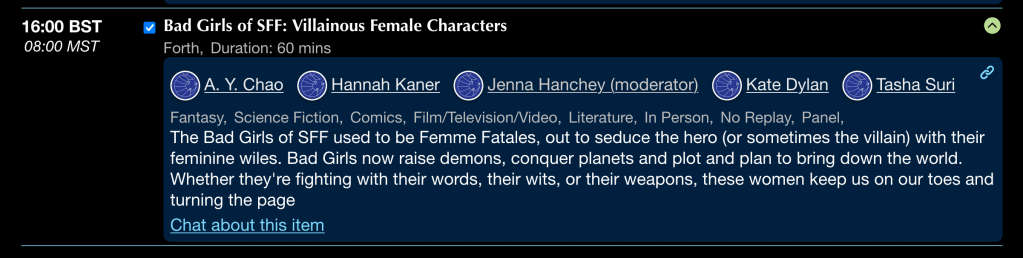
WorldCon was fabulous — I’m enamored with the circles of the SFF community that I find myself sharing space with. I shared meals and drinks and dancing and conversation and laughter with such wonderful folks. It’s such a joy to imagine justice and radical community with you all, and to learn from the ways that you’re growing and transforming as writers and people. And all my panels went well — though top billing goes to “Bad Girls of SFF” which might have been the most fun panel I’ve ever been a part of! Witty, hilarious, and profound at the same time, it was a delight to moderate!

After floundering through how to introduce myself to people (flash fiction writer? academic? poetry editor? reviewer? essayist? audio narrator?) it was nice to come home to a reminder that even though I may not be easily or neatly encapsulated, I do good work that people seem to enjoy: my newest story + my newest audio narration work came out in Simultaneous Times today!

I hope you enjoy “When You See a Dragon, You Run

Speaking of Simultaneous Times, and places where my dubious affiliation as a recurring narrator is somehow garnering me awards recognition, Simultaneous Times is shortlisted for *another award*! It’s up for The British Fantasy Award for Best Audio!! This magazine was started out of love for community, and it’s wonderful to see it being recognized for the supportive and enabling work it’s done.

Take care of each other, and stay tuned for upcoming posts on “Africanfuturism Beyond the Future” and the syllabus I’m currently working on for the beginning of the schoolyear, “Writing Speculative Fiction for Social Justice.”

Simultaneous Times Up for an Ignyte Award!

The fabulous fiction podcast Simultaneous Times is up for the Ignyte Award for Best Fiction Podcast! I’ve had the honor of being a recurring narrator on the podcast since earlier this year, after one of my stories with them (“Hello This is Automatic Antigrief: What Problem Can I Solve for You Today?“) was nominated for a British Science Fiction Award for Best Audio Fiction.

Fun fact: I didn’t know that being a recurring narrator and second pair of eyes on some submissions meant I was a part of the Simultaneous Times team…until Jean-Paul contacted me to make sure he had the pronunciation of my name right for the award announcements! What a delightful way to find out =)

As I’ve been thinking a lot about community and relations lately, it’s a really lovely reminder that I sometimes have more import and impact that I realize on those around me.

The nominees this year are amazing across the board — it’s an honor to be a small part of them ❤